Flint cars were produced from 1923 to 1927. Three different sizes of Flint were sold, all with six-cylinder engines.
On this page: History · Models · Literature · Known cars
History
The Flint Motor Car Company was created in July 1922, shortly after Durant’s purchase of the Willys-Overland factory in Elizabeth, New Jersey. The purchase included the prototype of a car that, with some modifications, became the Flint E-55.
Production of the E-55 began in June 1923 at the Durant Long Island City factory; Kimes reports that only 500 cars were produced that year.
In 1924 production of the E-55 moved to the Elizabeth factory and to a new factory in Flint, Michigan, and the smaller H-40 went into production. The H-40 was originally to have been sold as the Eagle.
During 1925 the H-40 was replaced by the B-40, which had a slightly more powerful engine and hydraulic brakes.
Three new models arrived in 1926: the B-60 replaced the B-40, the E-80 replaced the E-55, and the Z-18, known as the “Junior”, became the smallest and lowest-priced Flint. The Flint, Michigan factory was shut down and sold in 1926, and Flint production continued at Elizabeth. 1927 was the last year of Flint production.
Models by year and wheelbase
| Wheelbase | 1923 | 1924 | 1925 | 1926 | 1927 |
|---|---|---|---|---|---|
| 110 in. | Z-18 | Z-18 | |||
| 115 in. | H-40 | H-40, B-40 | B-40, B-60 | B-60 | |
| 120 in. | E-55 | E-55 | E-55 | E-55, E-80* | E-80* |
Models
E-55
The original Flint. A small number of 1923 models were built, with volume production beginning with the 1924 models. Its design was based on the prototype Durant obtained with the Elizabeth factory. Fact sheets: 1925 Flint E-55.
H-40
The H-40 began life as the Eagle, promoted in 1923 but never produced under that name. It became the Flint H-40, a smaller companion to the E-55. Fact sheets: 1925 Flint H-40.
B-40
Introduced in 1925 to replace the H-40, the B-40 had four-wheel hydraulic brakes. Fact sheets: 1925 Flint B-40, 1926 Flint B-40.
B-60 (Sixty)
The B-60 replaced the B-40 in 1926. Its new “Flint designed” engine gave top speeds of more than 60 miles per hour, with four-wheel hydraulic brakes. Fact sheets: 1926 Flint B-60.
E-80 (Eighty)
Introduced in 1926, the E-80 replaced the E-55 as the largest Flint. Fact sheets: 1926 Flint E-80.
Z-18 (Junior)
Introduced in 1926 and widely known as the Flint Junior, the Z-18 was the smallest Flint. Unusually for the time it had two-wheel mechanical brakes. Fact sheets: 1926 Flint Z-18 (Flint Junior).
Radiator badges

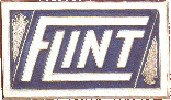
Flint 1924 to 1927 radiator badge
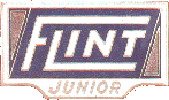
Flint 1926 to 1927 radiator badge
Sales literature and manuals
The Flint literature guide shows 26 sales brochures and folders from 1923 to 1927 and two 1924 parts books. A complete copy is in the members’ Durant Digital Library for two Flint instruction manuals.
Known surviving cars
The Flint registry lists 25 known cars by factory, car number and engine number, with photos of several.
Open question
Did a 1923 Flint exist, or were the first Flints sold as 1924 models? Automobile Quarterly reports that production began in June 1923, at both the Long Island City and new Flint, Michigan plants. The Durant Family Registry serial number list shows no 1923 Flint and has 1924 production beginning in August 1923 at serial number 100. Kimes shows a 1923 E-55 Touring and gives the years as 1923 to 1927. No 1923 sales brochure has been found. If you can help, please contact a technical advisor.
Related pages
- 1923–1924 Flint photo gallery
- 1925 and later Flint photo gallery
- Flint serial numbers
- Flint seals
- Model Reference for every Durant family make
Sources: Durant Family Registry, Durant’s Standard vol. 21 no. 1; Beverly Rae Kimes, Standard Catalog of American Cars 1805–1942; club registry records.