
The Eagle was a Durant Motors car announced in 1923 and displayed in January 1924, meant to fill the gap between the Star and the Durant. It never went into production.
On this page: History · Models · Literature
History
The Eagle Six had a 50 horsepower, 195.6 cubic inch Continental six-cylinder engine, four-wheel brakes and a 115 inch wheelbase. In March 1924 Durant announced that the Eagle Six would be replaced by the Flint 40, which became the Flint H-40.
Models
1924 Eagle Six
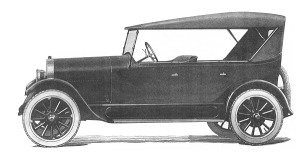
Special features
- 6 cylinder, 50 horsepower engine
- Durant tubular backbone
- Perfected four wheel brakes
- 115″ wheelbase
Body styles and prices
| Body style | Price |
|---|---|
| Touring Car | $820.00 |
Full specifications, 1924 Eagle Six
| Item | Specification |
|---|---|
| Engine | Six cylinders, “L” head type; 48 horsepower at 2,400 r.p.m.; bore, 3-18″; stroke 4-1/4″; 195.6 cubic inch displacement. |
| Cylinders | Cast en-bloc with upper half of crankcase. |
| Valves | 1-1/2″ diameter, 5/16″ lift. |
| Pistons | Three rings, 3/16″ wide, all above piston pin. |
| Connecting Rods | 8-1/4″ center to center; material is drop-forged steel; bearing is cast in rod; diameter, 2″; width, 1-1/2″; |
| Crankshaft | Four-bearing; front, 2″ diameter and 1-1/2″ long; both center bearings, 2″ diameter and 1-1/4″ long; rear bearing, 2″ diameter and 2-1/2″ long; all bearings easily accessible by removing oil pan without disturbing any other parts. |
| Camshaft | Four-bearing; carbon steel; case-hardened and ground. |
| Engine Lubrication | Force feed gear type oil pump; camshaft drilled and oil is forced to camshaft bearings through case to main crankshaft bearings and to connecting rod bearings. |
| Cooling System | Fedders radiator; honeycomb type, 16″ four-blade fan; water capacity of cooling system is 12 quarts. |
| Timing Gear Drive | Morse silent chain; simple adjustment. |
| Carburetor | 1 inch Tillotson carburetor; combination intake and exhaust manifold with hot spot; located on left side of engine and has carburetor attached. |
| Clutch | Single plate, dry type; enclosed in flywheel; easily adjusted or removed without disturbing engine or transmission. |
| Transmission | Warner standard selective type; three speeds forward and one reverse, located amidship of car. |
| Electric System | Auto-Lite starting motor, generator, coil and distributor; U.S.L. battery, 92 amp. hours. |
| Drive | Left-hand drive, with spark and throttle levers mounted on steering wheel; ignition and lighting switch mounted on instrument board. |
| Front Axle | Adams; reverse Elliott type, inclined king pins, tapered roller hub bearings. |
| Rear Axle | Adams; semi-floating type; spiral bevel pinion and ring gear; ratio, 4-7/9 to 1. |
| Brakes | Double-shoe type on front and rear wheels; operated from foot pedal; emergency connection to hand brake lever. |
| Springs | Semi-floating type; front, 35″ long; rear, 50-1/2″ long; spring bolts, 9/16″ diameter; front, seven leaves; rear, seven leaves; springs are 2″ wide. |
| Tires | 30″ x 3½” straight sided cord; demountable; spare rim furnished. |
| Chassis Lubrication | Alemite system. |
| Steering Gear | Warner worm and gear type; ball thrust bearings with adjustment to take up wear; 16″ steering wheel; horn button mounted on steering wheel. |
| Frame | Pressed steel with 4-1/2″ channel, 5/32″ thick; five cross members and four-point motor suspension. |
| Gasoline Supply | Stewart vacuum feed is used; gasoline tank located at rear of frame and has a capacity of 12 gallons. |
| Wheelbase | 115 inches |
| Headlamps | Drum-type, nickel-plated rim; equipped with Flare Lite reflector. |
| Horn | Motor-driven. |
References: original Eagle literature, A-24-1001-8.
Sales literature
Literature known to the club. Click a picture to enlarge it.
Sales brochures and folders
1924

Eagle 1924 sales literature, A-24-1001-8

- A-24-1001-8: Model: Six; date: 1924; dimensions: 6″ x 7¾”, opens to 6″ x 15½”.
Related pages
- Flint, which built the car as the H-40
- Princeton, another planned Durant make
- Model Reference for every Durant family make
Sources: Baldwin, Georgano, Sedgwick and Laban, The World Guide to Automobile Manufacturers, p. 156; Tad Burness, Monstrous American Car Spotter’s Guide 1920–1980; Durant Family Registry, Durant’s Standard vol. 21 no. 1; original Eagle literature.