One of the first jobs in any restoration is working out exactly what you have. The same car could be sold under a different name depending on the year and the country, so a complete description matters: it tells you which parts, specifications and literature apply. A complete description includes the year, make, model, body style, car number and, where you can find them, the engine type and serial number and the engine block and head casting dates.
On this page: Body data plate · Car number · Year · Make and badges · Model · Body style · Engine · Detective work · What is it worth?
Start with the body data plate
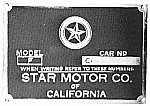
Find the body data plate in the engine compartment, on the firewall on the right-hand (passenger) side. If the plate is intact it gives you the make, the model and the car number, and the model and car number together will usually tell you the year.

Star Model F body data plate, Star Motor Co. of New Jersey

Star Model F body data plate, Star Motor Co. of California
The car number
The car number, or vehicle identification number, is the number you need to register and insure your car. It also tells you which factory built the car. The letter printed before the number on the plate is part of the car number, so always include it. The prefixes known to the club are:
| Prefix | Factory |
|---|---|
| C | Oakland, California |
| E | Elizabeth, New Jersey |
| F | Flint, Michigan (Flint cars) |
| L | Lansing, Michigan |
| M | Grand Rapids, Michigan (De Vaux) |
| N | Long Island City, New York |
| T | Leaside, Ontario, Canada |
With the model and car number in hand, look the number up in the serial number tables: Serial Numbers (all makes), Durant, Star, Star trucks, Rugby, Flint, Frontenac, De Vaux and Continental. Each fact sheet in the Model Reference also gives its serial number range.
The year
The model year is not recorded directly on the car, but there are good clues. The most direct is the body data plate: its make, model and car number can be matched against the serial number ranges in the fact sheets. If the plate is missing or illegible, compare the physical features of your car with the fact sheets, and check the engine block and head casting dates, remembering that the engine may have been replaced at some point.
The year the car was bought is not a reliable guide. New model-year production generally began in August, with the new models introduced in September, so a car bought in October 1928 may be a 1929 model, or a 1928 if the dealer had old stock. This became more of a problem in later years as sales fell and model changes came more often.
The make and radiator badges
The make is usually easy to tell: Durant, Star, Rugby, Flint and so on. The radiator badge also helps with the year, because different badges were used in different years. Click a badge to enlarge it. For how the makes relate to each other, see the Durant family timeline.
Durant 1921 to 1926 radiator badge
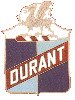
Durant 1928 radiator badge
Durant 1929 radiator badge
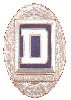
Durant 1931 to 1932 radiator badge

Star 1923 radiator badge

Star 1924 radiator badge

Star 1925 radiator badge

Star 1926 radiator badge

Star 1926 to 1927 four-cylinder radiator badge

Star 1926 to 1927 six-cylinder radiator badge
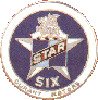
Star 1928 four-cylinder radiator badge

Rugby 1924 to 1925 radiator badge
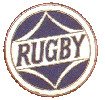
Rugby 1926 to 1927 four-cylinder radiator badge
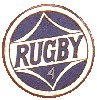
Rugby 1926 to 1927 six-cylinder radiator badge
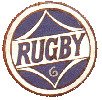
Rugby 1928 to 1929 radiator badge

Rugby 1930 to 1931 radiator badge

Flint 1924 to 1927 radiator badge
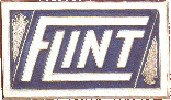
Flint 1926 to 1927 radiator badge
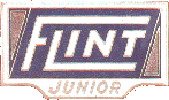
Mason radiator badge
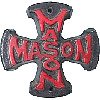
De Vaux 1931 to 1932 radiator badge
Frontenac 1931 to 1932 radiator badge

Frontenac 1932 radiator badge
Frontenac radiator badge (33)

The model
Each make was built in several models, with different engines, chassis and equipment. The model is usually on the body data plate. Once you know it, the fact sheets in the Model Reference give the body styles, prices, serial number range and specifications for each model and year: see Durant, Star, Flint, Frontenac, De Vaux and Locomobile.
The body style
Like other makers of the time, Durant offered each model in many body styles. The body style is usually a matter of inspecting the car; if the body is missing or badly altered, it may not be possible to tell. Use this list together with the fact sheet for your model.
| Body style | Description |
|---|---|
| Coach or Brougham | A two-door, five-passenger car. At first called a coach; in later years a brougham. |
| Cabriolet | A two-passenger car offered, depending on the model and year, with a hard top or a folding top. |
| Coupe or Coupster | A hard-top, two-passenger car, sometimes with an optional rumble seat. |
| Landau or Landau Sedan | Essentially a four-door sedan with oval side windows at the rear. |
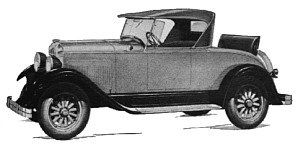
| Runabout or Roadster | A two-passenger car with a folding top, sometimes with a rumble seat for five passengers. Runabout was used in the early years; roadster is the common term. |
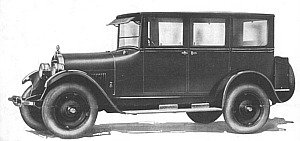
| Sedan | The most basic style, offered on almost every model. Usually five passengers; some sedans seated seven. |
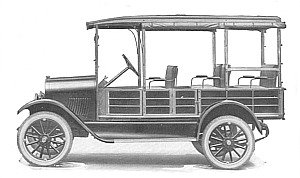
| Station Wagon | Perhaps the most famous Star body style: the original “woody” wagon. |
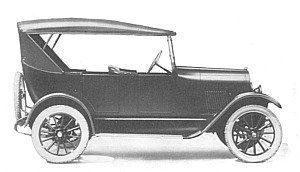
| Touring or Phaeton | Until about 1928 a five-passenger car with a folding top was a touring car; from 1929 the term was phaeton. Some were offered with an optional winter top that turned the car into a hard top. |
1926 Flint Z-18 Coach
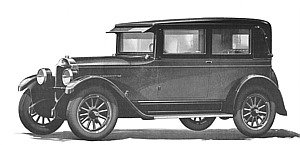
1929 Durant 60 De Luxe Convertible Cabriolet
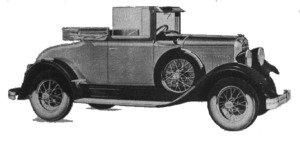
1930 Durant 407 Standard Coupe
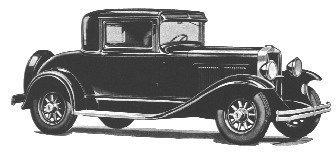
1929 Durant 40 Roadster
1925 Durant A-22 Special Sedan
1923 Star C Station Wagon
1923 Star C Touring
The engine
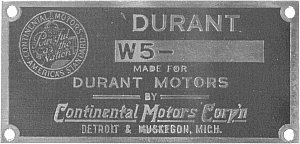
The engine type and serial number are on a plate, usually on the left side of the engine. Most cars in the Durant family used Continental engines, and the plate names the engine model: the example below is a W5 made for Durant Motors by Continental. The Engines page shows which engine models went into which cars. Note the engine block and head casting dates too; they help narrow down the year, but be careful, because engines and heads were often replaced during a car’s life.
Detective work: when there is no plate
If the body data plate is missing, collect as much of the following as you can, then compare it with the fact sheets, photo galleries and literature on this site:
- Engine type and serial number (the plate on the left side of the engine)
- Engine block casting date and head casting date
- Number of cylinders
- Whether there is an air filter or an oil filter
- Transmission: number of forward speeds, and whether it has “free wheeling”
- Brakes: two-wheel or four-wheel; two-shoe or three-shoe; internal or external
- Wheels: wood, steel disc or wire; number of rear wheels
- Wheelbase, measured from the center of the front axle to the center of the rear axle
- Radiator badge type (different badges were used in different years)
- Number and length of the leaf springs, front and rear
Still stuck? The club’s technical advisors are happy to help, and adding your car to the club registry helps everyone.
What is it worth?
This is the question the club is asked most often. Collector-car price guides give values by year, body style and condition; if your exact car is not listed, use a Durant family car of similar year, body style and condition. Recent sales listings for Durant, Star, Rugby, Flint and the other makes give a feel for the market. If you need an exact figure, use a professional appraiser: many local car clubs offer appraisal services, or ask your insurance company whom to use.
Related pages
- Durant family timeline, 1921 to 1933
- Engines used in the Durant family
- Further reading and museums
- Tech Info
Sources: Durant Family Registry, Durant’s Standard; club registry records.